Here's some analysis from the Poynter Institute's business desk that anyone with a remote interest in the welfare of the Pioneer Press and other MediaNews holdings will want to read:
Poynter Biz blog on newspaper debt
Poynter Media Business Analyst Rick Edmonds tracks the latest industry developments.
Add/View All The Biz Blog Feedback
More The Biz Blog RSSPrint this Page
WEDNESDAY, JUNE 18, 2008Posted at 9:54:37 AM
It's the Debt, Stupid
When Sam Zell and his lieutenants or Dean Singleton opine on the state of the newspaper industry and the drastic remedies required, as they have in recent weeks, it puts me in a mood to scream.
Yes, times are tough. But the latest draconian cuts they are imposing on employees and readers are going largely to service the ridiculous levels of debt they had the bad judgment to take on.
Let's look at the numbers. Zell's Tribune began life last December with more than $12 billion in debt. Goldman Sachs analyst Peter Appert wrote then that the company would face around $1 billion in debt payments this year, which cash flow from its operations would barely cover.
Things aren't working out even that well, with revenue declines much worse than expected. For the first quarter of 2008, Tribune reported cash flow of about $200 million from operations. Interest payments totaled $263 million. Forget profits, obscene or otherwise, the company operated at a loss.
Turning to Singleton's MediaNews, it reported interest payments of about $80 million in 2007, sucking up about 6 percent of the revenue its newspapers generated.
MediaNews stopped reporting its financials in April, but it is reasonable to assume debt service remains about the same in 2008 at the same time revenues, and earnings, keep falling (as they are throughout the industry).
By contrast, an extremely conservative borrower, the Washington Post Co., had interest payments of only $12 million in 2007. Its diverse businesses generated revenue of over $4 billion, more than triple those of MediaNews.
So when Tribune announces it will "right-size" by getting the split of advertising and news space to 50-50 in its papers, I wonder whether this abnormal level of shoehorning news is largely a ploy to finance debt.
When Singleton boasts to an international conference in Sweden of his progressive step of depriving various of his California papers of local-based publishers and copy desks, I think I know why no other major American publishing group has gone that far. Feeling prosecutorial about these exercises in making a difficult situation worse, I do need to add a few qualifiers.
The Tribune deal came with a huge tax benefit and an understanding that some assets would need to be sold. MediaNews operates on a model distinctly its own, including joint operating agreements for three of its biggest papers and a number of management contracts, particularly with well-heeled Hearst.
Being highly leveraged has always been part of the game plan, and Singleton has been shrewd lately about getting paid without committing his own capital. You could also argue that the industry has consistently underestimated how much revenue and earnings will fall.
If that is still the case, Tribune and MediaNews could be avatars of deeper cuts other companies may resort to in another six months to a year. Also we are past the point where cutting the newspaper expense base can reasonably be blamed on greedy, bad-guy managers.
If an industry loses 20 percent of revenues over two years, more in problem spots like Florida and California, you don't need an M.B.A. to figure out the necessity of bringing down costs. Still, I think operators like Zell and Singleton are squishy where others are forthright on the concurrent need to keep heft and quality in the print product and invest aggressively in new digital operations.
Frankly, I don't think they have the money to do it -- because the banker has to be paid first.
In December 2006, Craigslist CEO Jim Buckmaster spoke to an investors' conference in New York. Asked the inevitable question about whether he felt guilty about helping destroy the industry's classified base, he replied that he and Craig Newmark thought the bigger problem was excessive debt. (Craigslist, essentially, has none).
Both are problems, but I do think debt has become a very important gradient now when looking at companies. Zell, Singleton, McClatchy and private groups in Minneapolis and Philadelphia all labor under the burden of having bought papers assuming earnings as they were instead of earnings as they have become.
McClatchy announced deep cuts of its own this week and carries big debt from laying out $4 billion (after the sale of some papers) for Knight Ridder just as the business turned from stalled to plunging in mid-2005. But McClatchy also sold its largest paper, the Star Tribune of Minneapolis, ahead of the curve of sinking valuations and has actually been paying down debt as well as covering interest payments.
Conversely, some companies have had the good sense or good fortune not to buy any newspapers this decade. That hasn't earned them favor on Wall Street, but it does leave a lot more maneuvering room for transformation in the next several years.
That group would include, among others, A.H. Belo, E.W. Scripps, the Washington Post and New York Times companies, and Cox. I don't think it coincidental that you see some of the boldest digital experiments and strongest online growth rates at the newspapers of these companies.
-- END --
Saturday, June 21, 2008


Tuesday, June 17, 2008
McClatchy newspapers slash hundreds of jobs today
Someday, the cuts to the newspaper industry will equalize with job gains elsewhere in the media world (I hope), and this brave new thing that will rise up to replace the printed word will materialize, offering us all quality journalism without the ink stains on our hands and feet. (Well, your hands... my feet...)
Someday.
But not today.
McClatchy, the former owner of the Minneapolis Star Tribune, slashed 1,400 jobs across the country Monday morning, including 250 at the Miami Herald alone.
News article on this crap here
That's a 10 percent reduction.
Imagine losing 10 percent of your body weight all at once ... or 10 percent of your extended family ... or 10 percent of your co-workers.
McClatchy had previously cut 2,000 jobs over the course of 18 months, so this latest bolt of pain is just a sudden amputation on top of the loss of the larger limb that had been hacked off a little more gradually.
Cry, cry for the newsfolk....
They need it!
FYI: McClatchy-owned newspapers include The Miami Herald, The Sacramento Bee, the Fort Worth Star-Telegram, The Kansas City Star, the Charlotte Observer.
McClatchy.com
Someday.
But not today.
McClatchy, the former owner of the Minneapolis Star Tribune, slashed 1,400 jobs across the country Monday morning, including 250 at the Miami Herald alone.
News article on this crap here
That's a 10 percent reduction.
Imagine losing 10 percent of your body weight all at once ... or 10 percent of your extended family ... or 10 percent of your co-workers.
McClatchy had previously cut 2,000 jobs over the course of 18 months, so this latest bolt of pain is just a sudden amputation on top of the loss of the larger limb that had been hacked off a little more gradually.
Cry, cry for the newsfolk....
They need it!
FYI: McClatchy-owned newspapers include The Miami Herald, The Sacramento Bee, the Fort Worth Star-Telegram, The Kansas City Star, the Charlotte Observer.
McClatchy.com
Thursday, June 12, 2008
Strange Days and Carrie Bradshaw
I have seen everything and it is strange.
Two women and a gay man just shared a sugar cookie three-ways in my office.
One of the women is now walking around the office, trying to unload the remaining THIRD of the cookie on whoever wants it..
It is a Carrie Bradshaw cookie. As in, the star of Sex and the City, sitting with legs crossed on a bench, looking glamorous, sugar-coated onto a cookie.
Two women and a gay man just shared a sugar cookie three-ways in my office.
One of the women is now walking around the office, trying to unload the remaining THIRD of the cookie on whoever wants it..
It is a Carrie Bradshaw cookie. As in, the star of Sex and the City, sitting with legs crossed on a bench, looking glamorous, sugar-coated onto a cookie.
Monday, June 9, 2008
Dry Drowning, the bizarrest way to die?
It works like this: You step out of the pool with water in your lungs. You don't feel perfect, nor do you feel terrible. You go home tired. Then, about 24 hours later (or less), you die. As in, you're dead.
Don't believe me? Dry Drowning supposedly kills about 300 or so people a year in the U.S.A.
You could be next, bucko!!!
I don't mean to make light. This case is truly sad:
‘Dry drowning’ claims 10-year-old’s life - Health - MSNBC.comThe tragic death of a South Carolina 10-year-old more than an hour after he had gone swimming has focused a spotlight on the little-known phenomenon called ...
www.msnbc.msn.com/id/24982210/>1=43001 - 43k - Cached - Similar pages
So after reading the above article, I looked up the official Wikipedia definition of Dry Drowning here, and I nary understood nary a nary word, narily:
Dry drowning - Wikipedia, the free encyclopediaIn cases of dry drowning in which the victim was immersed, very little fluid is aspirated into the lungs. The laryngospasm reflex essentially causes ...
en.wikipedia.org/wiki/Dry_drowning - 24k - Cached - Similar pages
Don't believe me? Dry Drowning supposedly kills about 300 or so people a year in the U.S.A.
You could be next, bucko!!!
I don't mean to make light. This case is truly sad:
‘Dry drowning’ claims 10-year-old’s life - Health - MSNBC.comThe tragic death of a South Carolina 10-year-old more than an hour after he had gone swimming has focused a spotlight on the little-known phenomenon called ...
www.msnbc.msn.com/id/24982210/>1=43001 - 43k - Cached - Similar pages
So after reading the above article, I looked up the official Wikipedia definition of Dry Drowning here, and I nary understood nary a nary word, narily:
Dry drowning - Wikipedia, the free encyclopediaIn cases of dry drowning in which the victim was immersed, very little fluid is aspirated into the lungs. The laryngospasm reflex essentially causes ...
en.wikipedia.org/wiki/Dry_drowning - 24k - Cached - Similar pages
Friday, May 23, 2008
More on reporter-blogger-intellectual
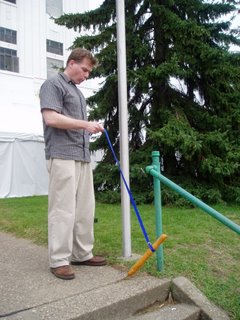
Pioneer Press reporter Alex Friedrich's heralded State Fair blog, pushing the envelope of toilet humor and gastrointestinal distress, here:
minnesotastatefair.blogspot.com
London School of Economics steals Pioneer Press reporter
My sources at the PiPress have forwarded me a goodbye speech for a good guy and one heck of a good reporter. It's worth reading.
--------
Union organizer and reporter par excellence, Alex Friedrich, is leaving the Pioneer Press today (Friday) to pursue a master's degree in European History at the London School of Economics.
Friedrich was a unit chair with the Minnesota Newspaper Guild, of the Communications Workers of America Local 37002.
More on him here:
http://www.shoptalknet.org/index.php?get=Alex+Friedrich
His co-worker, Fred Melo, sent this email around to everyone in the newsroom, after the 4 p.m. goodbye speeches and cake.
-----
Here's the goodbye-to-Alex speech I would have given 20 minutes ago, had that Q@#$%$^ not cut me off in traffic and had the police chief spoken a little bit faster. Not my fault, I double-pinky swear. (Well....):
Alex was my first male friend at the Pioneer Press and... (Hmmm... Let me try that again with another lede here... )
Alex's reporting life has taken him from Germany and Prague to the rain-soaked streets of a post-Hurricane Katrina Mississippi, not to forget the hazardous byways of Internet blogging (without pooping. If you don't know what I'm taking about, do a search for Friedrich and State Fair).
But this was not my primary way of knowing Alex or accessing the open library inside his head. Truth be told, I rarely read his beat stuff. Washington County? Might as well be Guam to me.
Few people realize how hard Alex worked for all of us -- as a newsroom, as a paper, and as a brave but embattled industry -- once his computer shut off and he "went home" for the day.
On a near-nightly basis, his was the face and voice of reporters, editors and photographers, writing and researching and organizing the stuff that most of us don't have the stomach for. Mondays at noon, week in and week out, he was there come heck or come highwater, meeting with co-workers across departments, planner in hand.
Whatever our remaining challenges as a paper and as an industry, the short-term results have been better than many expected. I truly believe Alex Friedrich and the loyalty he inspired is a signifcant reason why the Pioneer Press is growing circulation, while the competition isn't.
His was leadership with a smile, and he always maintained a forward-thinking, solution-oriented way of figuring how to improve life here for all of us, and not just for a particular segment of the newsroom.
Leave it to a beautiful woman to steal his heart and kidnap him off to the London School of Economics. Not too shabby, young man. Sounds like a permanent contract to me.
Now go forth and multiply....
Frederick Melo
Reporter, St. Paul Pioneer Press
345 Cedar St., St. Paul, MN 55101
Office: 651.228.2172 | Mobile: 651.398.5534
Fax: 651.228.5500
fmelo@pioneerpress.com | www.twincities.com
--------
Union organizer and reporter par excellence, Alex Friedrich, is leaving the Pioneer Press today (Friday) to pursue a master's degree in European History at the London School of Economics.
Friedrich was a unit chair with the Minnesota Newspaper Guild, of the Communications Workers of America Local 37002.
More on him here:
http://www.shoptalknet.org/index.php?get=Alex+Friedrich
His co-worker, Fred Melo, sent this email around to everyone in the newsroom, after the 4 p.m. goodbye speeches and cake.
-----
Here's the goodbye-to-Alex speech I would have given 20 minutes ago, had that Q@#$%$^ not cut me off in traffic and had the police chief spoken a little bit faster. Not my fault, I double-pinky swear. (Well....):
Alex was my first male friend at the Pioneer Press and... (Hmmm... Let me try that again with another lede here... )
Alex's reporting life has taken him from Germany and Prague to the rain-soaked streets of a post-Hurricane Katrina Mississippi, not to forget the hazardous byways of Internet blogging (without pooping. If you don't know what I'm taking about, do a search for Friedrich and State Fair).
But this was not my primary way of knowing Alex or accessing the open library inside his head. Truth be told, I rarely read his beat stuff. Washington County? Might as well be Guam to me.
Few people realize how hard Alex worked for all of us -- as a newsroom, as a paper, and as a brave but embattled industry -- once his computer shut off and he "went home" for the day.
On a near-nightly basis, his was the face and voice of reporters, editors and photographers, writing and researching and organizing the stuff that most of us don't have the stomach for. Mondays at noon, week in and week out, he was there come heck or come highwater, meeting with co-workers across departments, planner in hand.
Whatever our remaining challenges as a paper and as an industry, the short-term results have been better than many expected. I truly believe Alex Friedrich and the loyalty he inspired is a signifcant reason why the Pioneer Press is growing circulation, while the competition isn't.
His was leadership with a smile, and he always maintained a forward-thinking, solution-oriented way of figuring how to improve life here for all of us, and not just for a particular segment of the newsroom.
Leave it to a beautiful woman to steal his heart and kidnap him off to the London School of Economics. Not too shabby, young man. Sounds like a permanent contract to me.
Now go forth and multiply....
Frederick Melo
Reporter, St. Paul Pioneer Press
345 Cedar St., St. Paul, MN 55101
Office: 651.228.2172 | Mobile: 651.398.5534
Fax: 651.228.5500
fmelo@pioneerpress.com | www.twincities.com
Friday, May 9, 2008
Michael Bhatia, Brown scholar, killed in Afghanistan
A good man died in Afghanistan on Wednesday. He was an Oxford scholar and an intellectual and I'd like to think of him as a friend, though we hadn't stayed in touch like we should have over the years.
His name was Michael Bhatia, and to call him smart is like calling the Pope a Catholic. Bhatia, of Medway, Massachusetts, did his first mission in sub-Saharan Africa with a United Nations crisis team while he was a sophomore in college. He studied toward his Phd at Oxford and taught at his alma mater, Brown University in Rhode Island, in recent months.
He was 30 or 31 years old.
His subject of choice was war. But his was no mere theoretical or intellectual exercise. He was one of those rare academics that believed in putting the books down at the end of the semester and talking to people -- real, everyday people -- in their homes, in their villages, and seeing the world through their eyes. He was an idealist. He wanted peace.
He traveled to East Timor, Afghanistan, and any number of crisis locations hoping to learn and to help people. The U.S. military hired him as a cultural adviser of sorts in Afghanistan. Scattered blog and media reports indicate his convoy hit some form of explosive. I'm not sure if it was a cast-away boobie trap in the style of a landmine or more of an organized attack.
To say he is mourned and loved is an understatement. We miss you Mike. We'll see you again someday.
More on Michael Bhatia here:
Brown University's Watson Insitute memorial tribute:
http://watsoninstitute.org/news_detail.cfm?id=851
Brown University's alumni magazine posting:
http://www.brownalumnimagazine.com/recent_news/michael_bhatia_99_killed_in_afghanistan_1980.html
Reuters describes the attack that likely killed Mike:
http://africa.reuters.com/world/news/usnISL72960.html
Mike's bio on the Globalist:
http://www.theglobalist.com/AuthorBiography.aspx?AuthorId=988
Mike's three-part personal photo series on life in Afghanistan:
http://www.theglobalist.com/StoryId.aspx?StoryId=6416
Zohra, a blog friend from Afghanistan, remembers Mike:
http://kabulkabul.blogspot.com/2008/05/in-memory-of-michael-bhatia.html
A Brown friend and drinking buddy remembers Mike:
http://sethresler.wordpress.com/2008/05/09/michael-bhatia/
FROM THE WATSON INSTITUTE AT BROWN UNIVERSITY:
In Memory of Michael Vinay Bhatia '99
Michael Bhatia
May 08, 2008
Michael Vinay Bhatia ’99 died yesterday in Afghanistan, where he was working as a social scientist in consultation with the US Defense Department.
In addition to graduating magna cum laude in international relations from Brown University, Michael was a visiting fellow at the Watson Institute from July 2006 to June 2007. At the Institute, he was involved in a research project on Cultural Awareness in the Military, writing his PhD dissertation, and teaching a senior seminar on "The US Military: Global Supremacy, Democracy and Citizenship."
Over several years, Michael’s research and humanitarian work took him to such conflict zones as Sahrawi refugee camps, East Timor, and Kosovo, in addition to Afghanistan.
Of his work in Afghanistan, Michael wrote in November: “The program has a real chance of reducing both the Afghan and American lives lost, as well as ensuring that the US/NATO/ISAF strategy becomes better attuned to the population's concerns, views, criticisms and interests and better supports the Government of Afghanistan.”
Michael had recently published some of his research on Afghanistan.
His co-authored book on Afghanistan, Arms and Conflict: Armed Groups, Disarmament and Security in a Post-War Society was just released by Routledge in April. It assesses small arms and security-related issues in post-9/11 Afghanistan.
His edited book on Terrorism and the Politics of Naming was published by Routledge last September. Stating that names are not objective, the book seeks the truth behind those assigned in such cases as the US hunt for al-Qaeda, Russia’s demonization of the Chechens, and the Israeli-Palestinian conflict.
In August, his personal three-part photo essay, “Shooting Afghanistan: Beyond the Conflict,” was published by theGlobalist. In it, he wrote:
“Afghanistan will soon reach a desperate milestone – the thirtieth anniversary of ongoing conflict. … Though I have spent the majority of my time there researching the wars and those involved in it, conflict is not my primary memory and way of knowing it. I am compelled to write about experiences and ideas that cannot be placed into analytical paradigms, which do not speak to theories of war or peace, to destruction or to reconstruction, but instead to daily interactions that occurred in the course of research.”
His love of photography is revealing. In theGlobalist piece, he also wrote:
“Building on Robert Capa’s statement that 'If your pictures aren't good enough, you're not close enough,' James Nachtwey, the preeminent photo-realist and conflict photographer, once indicated that the primary characteristic of a good war photographer was proximity, closeness and involvement.”
Michael was a doctoral candidate in the Department of Politics and International Relations at the University of Oxford. He was awarded a George C. Marshall Scholarship in 2001 and a Scoville Peace Fellowship in 2000, supporting residence at the Center for Strategic and Budgetary Assessments in Washington, DC.
He was working on his dissertation, titled “The Mujahideen: A Study of Combatant Motives in Afghanistan, 1978-2005,” based on 350 interviews with combatants throughout Afghanistan, as well as archival and media research. He has also conducted research in Afghanistan for the Overseas Development Institute, the Small Arms Survey, the Afghanistan Research and Evaluation Unit, the UK Department for International Development (via the International Policy Institute, King’s College, London), and the Organization for Security and Cooperation in Europe.
Before his fellowship at the Institute, he was a sessional lecturer on the causes of war in the Department of Political Science at Carleton University in Ottawa.
He is the author of War and Intervention: Issues for Contemporary Peace Operations (Kumarian Press, 2003); and of articles in the Bulletin of the Atomic Scientists, Global Governance, Review of African Political Economy, The International Journal of Refugee Law, International Peacekeeping, and Middle East Policy. He was the guest editor of The Third World Quarterly Special Issue: “The Politics of Naming: Rebels, Terrorists, Criminals, Bandits and Subversives,” which was then released as a book by Routledge. He received his MSc in international relations research from the Department of Politics and International Relations, University of Oxford.
“It's a terrible loss of someone so young, who had already accomplished a great deal, but had so much more to contribute,” said Institute Professor Thomas J. Biersteker, who advised Michael in his studies over the years.
Details about services will be made available.
Read Michael's personal photo essays here:
Globalist essay
Michael's information from Oxford University's St. Antony's College is here.
Read a UN statement given by Michael as an undergraduate here.
His name was Michael Bhatia, and to call him smart is like calling the Pope a Catholic. Bhatia, of Medway, Massachusetts, did his first mission in sub-Saharan Africa with a United Nations crisis team while he was a sophomore in college. He studied toward his Phd at Oxford and taught at his alma mater, Brown University in Rhode Island, in recent months.
He was 30 or 31 years old.
His subject of choice was war. But his was no mere theoretical or intellectual exercise. He was one of those rare academics that believed in putting the books down at the end of the semester and talking to people -- real, everyday people -- in their homes, in their villages, and seeing the world through their eyes. He was an idealist. He wanted peace.
He traveled to East Timor, Afghanistan, and any number of crisis locations hoping to learn and to help people. The U.S. military hired him as a cultural adviser of sorts in Afghanistan. Scattered blog and media reports indicate his convoy hit some form of explosive. I'm not sure if it was a cast-away boobie trap in the style of a landmine or more of an organized attack.
To say he is mourned and loved is an understatement. We miss you Mike. We'll see you again someday.
More on Michael Bhatia here:
Brown University's Watson Insitute memorial tribute:
http://watsoninstitute.org/news_detail.cfm?id=851
Brown University's alumni magazine posting:
http://www.brownalumnimagazine.com/recent_news/michael_bhatia_99_killed_in_afghanistan_1980.html
Reuters describes the attack that likely killed Mike:
http://africa.reuters.com/world/news/usnISL72960.html
Mike's bio on the Globalist:
http://www.theglobalist.com/AuthorBiography.aspx?AuthorId=988
Mike's three-part personal photo series on life in Afghanistan:
http://www.theglobalist.com/StoryId.aspx?StoryId=6416
Zohra, a blog friend from Afghanistan, remembers Mike:
http://kabulkabul.blogspot.com/2008/05/in-memory-of-michael-bhatia.html
A Brown friend and drinking buddy remembers Mike:
http://sethresler.wordpress.com/2008/05/09/michael-bhatia/
FROM THE WATSON INSTITUTE AT BROWN UNIVERSITY:
In Memory of Michael Vinay Bhatia '99
Michael Bhatia
May 08, 2008
Michael Vinay Bhatia ’99 died yesterday in Afghanistan, where he was working as a social scientist in consultation with the US Defense Department.
In addition to graduating magna cum laude in international relations from Brown University, Michael was a visiting fellow at the Watson Institute from July 2006 to June 2007. At the Institute, he was involved in a research project on Cultural Awareness in the Military, writing his PhD dissertation, and teaching a senior seminar on "The US Military: Global Supremacy, Democracy and Citizenship."
Over several years, Michael’s research and humanitarian work took him to such conflict zones as Sahrawi refugee camps, East Timor, and Kosovo, in addition to Afghanistan.
Of his work in Afghanistan, Michael wrote in November: “The program has a real chance of reducing both the Afghan and American lives lost, as well as ensuring that the US/NATO/ISAF strategy becomes better attuned to the population's concerns, views, criticisms and interests and better supports the Government of Afghanistan.”
Michael had recently published some of his research on Afghanistan.
His co-authored book on Afghanistan, Arms and Conflict: Armed Groups, Disarmament and Security in a Post-War Society was just released by Routledge in April. It assesses small arms and security-related issues in post-9/11 Afghanistan.
His edited book on Terrorism and the Politics of Naming was published by Routledge last September. Stating that names are not objective, the book seeks the truth behind those assigned in such cases as the US hunt for al-Qaeda, Russia’s demonization of the Chechens, and the Israeli-Palestinian conflict.
In August, his personal three-part photo essay, “Shooting Afghanistan: Beyond the Conflict,” was published by theGlobalist. In it, he wrote:
“Afghanistan will soon reach a desperate milestone – the thirtieth anniversary of ongoing conflict. … Though I have spent the majority of my time there researching the wars and those involved in it, conflict is not my primary memory and way of knowing it. I am compelled to write about experiences and ideas that cannot be placed into analytical paradigms, which do not speak to theories of war or peace, to destruction or to reconstruction, but instead to daily interactions that occurred in the course of research.”
His love of photography is revealing. In theGlobalist piece, he also wrote:
“Building on Robert Capa’s statement that 'If your pictures aren't good enough, you're not close enough,' James Nachtwey, the preeminent photo-realist and conflict photographer, once indicated that the primary characteristic of a good war photographer was proximity, closeness and involvement.”
Michael was a doctoral candidate in the Department of Politics and International Relations at the University of Oxford. He was awarded a George C. Marshall Scholarship in 2001 and a Scoville Peace Fellowship in 2000, supporting residence at the Center for Strategic and Budgetary Assessments in Washington, DC.
He was working on his dissertation, titled “The Mujahideen: A Study of Combatant Motives in Afghanistan, 1978-2005,” based on 350 interviews with combatants throughout Afghanistan, as well as archival and media research. He has also conducted research in Afghanistan for the Overseas Development Institute, the Small Arms Survey, the Afghanistan Research and Evaluation Unit, the UK Department for International Development (via the International Policy Institute, King’s College, London), and the Organization for Security and Cooperation in Europe.
Before his fellowship at the Institute, he was a sessional lecturer on the causes of war in the Department of Political Science at Carleton University in Ottawa.
He is the author of War and Intervention: Issues for Contemporary Peace Operations (Kumarian Press, 2003); and of articles in the Bulletin of the Atomic Scientists, Global Governance, Review of African Political Economy, The International Journal of Refugee Law, International Peacekeeping, and Middle East Policy. He was the guest editor of The Third World Quarterly Special Issue: “The Politics of Naming: Rebels, Terrorists, Criminals, Bandits and Subversives,” which was then released as a book by Routledge. He received his MSc in international relations research from the Department of Politics and International Relations, University of Oxford.
“It's a terrible loss of someone so young, who had already accomplished a great deal, but had so much more to contribute,” said Institute Professor Thomas J. Biersteker, who advised Michael in his studies over the years.
Details about services will be made available.
Read Michael's personal photo essays here:
Globalist essay
Michael's information from Oxford University's St. Antony's College is here.
Read a UN statement given by Michael as an undergraduate here.
Tuesday, May 6, 2008
Could the Pioneer Press buy the Star Tribune?
Dean Singleton, the owner of the Media News Group (the Denver-based company that bought the Pioneer Press after Knight Ridder dissolved) has made a career of buying papers in crisis, gutting their staffs, and then cracking the whip. It's publish or perish.
It's a strategy that has supposedly made Singleton a multi-millionaire. Or is that billionaire?
For years, the talk was that the Star Tribune would oneday absorb the Pioneer Press, a stalwart underdog in one of the last great media rivalries in the United States of America.
But if the Avista Corp., which bought the Star Tribune not long ago and has no great love of media holdings, is doing as poorly financially as it claims to be, perhaps things could go the other way around?
City Pages ponders the possibility and dishes on the Star Tribune's meager finances here, as the New York Post did before it:
City Pages article on the Star Tribune
Singleton could, in theory, ride in and buy the Star Tribune, and either merge the two papers or create a joint operating agreement of sorts. Shared content. Shared printing presses. But separate identities, each capitalizing on the loyal fan base for each paper in each city.
A group of eight rival newspapers in Ohio just did something along a similar vein here, sharing content between them as an answer to the Associated Press rate hike:
More on the operating agreement-style parternship here:
Ohio papers share content
It's a strategy that has supposedly made Singleton a multi-millionaire. Or is that billionaire?
For years, the talk was that the Star Tribune would oneday absorb the Pioneer Press, a stalwart underdog in one of the last great media rivalries in the United States of America.
But if the Avista Corp., which bought the Star Tribune not long ago and has no great love of media holdings, is doing as poorly financially as it claims to be, perhaps things could go the other way around?
City Pages ponders the possibility and dishes on the Star Tribune's meager finances here, as the New York Post did before it:
City Pages article on the Star Tribune
Singleton could, in theory, ride in and buy the Star Tribune, and either merge the two papers or create a joint operating agreement of sorts. Shared content. Shared printing presses. But separate identities, each capitalizing on the loyal fan base for each paper in each city.
A group of eight rival newspapers in Ohio just did something along a similar vein here, sharing content between them as an answer to the Associated Press rate hike:
More on the operating agreement-style parternship here:
Ohio papers share content
Hillary, please go away.
Message to Hillary Clinton:
Please. go. away.
You're not helping. You will never defeat John McCain in the general election. Maybe Obama can. Maybe he can't. But at least he's got a shot. You don't. Now go clutch success from the jaws of defeat by rallying women voters and Latinos for Obama. That would get McCain on the ropes. That it would. Yes it would.
The minority vote was a hugely decisive factor in Bill Clinton's two victories. And Gore and Kerry's inability to excite and attract minorities in their close races against Bush are why they failed. Hands down.
You wanna win, go for the 'brown' vote.
More on why minority voters may stay home if Hillary wins, thereby giving McCain the advantage, here:
http://www.chron.com/disp/story.mpl/politics/5751006.html
Please. go. away.
You're not helping. You will never defeat John McCain in the general election. Maybe Obama can. Maybe he can't. But at least he's got a shot. You don't. Now go clutch success from the jaws of defeat by rallying women voters and Latinos for Obama. That would get McCain on the ropes. That it would. Yes it would.
The minority vote was a hugely decisive factor in Bill Clinton's two victories. And Gore and Kerry's inability to excite and attract minorities in their close races against Bush are why they failed. Hands down.
You wanna win, go for the 'brown' vote.
More on why minority voters may stay home if Hillary wins, thereby giving McCain the advantage, here:
http://www.chron.com/disp/story.mpl/politics/5751006.html
Saturday, April 26, 2008
Save the world!!! ... by starving the poor?
Every policy decision that fixes a problem creates a new one. Ain't that a fact.
At my last meeting of my Spanish-language discussion group, the subject was literature and the environment.
A Costa Rican economic development dude who works with Latin businesses up and down Lake Street, brought up ethanol and biofuels, and how they've been a double-edged sword for developing countries, and probably for the U.S., too. It was once foreseen that increased demand for corn-based fuel products would give poor countries something they could market to the world.
Corn is relatively common and inexpensive to grow, after all.
That plan has worked -- in a strange way, almost too well. The growing price of corn is hitting the poor where it hurts most by raising food costs everywhere.
For more on that, here's an article from the Star Tribune:
"Rush to biofuels leaves a world of emptier plates
In 2007, two University of Minnesota economists forecast that biofuels would sharply increase food prices by 2020, leading to many more empty bellies in the world. How wrong they were. It took only a year. Updated 20 minutes ago"
Here's what I have to say, and the world had better by god damn listening:
Ouch!
At my last meeting of my Spanish-language discussion group, the subject was literature and the environment.
A Costa Rican economic development dude who works with Latin businesses up and down Lake Street, brought up ethanol and biofuels, and how they've been a double-edged sword for developing countries, and probably for the U.S., too. It was once foreseen that increased demand for corn-based fuel products would give poor countries something they could market to the world.
Corn is relatively common and inexpensive to grow, after all.
That plan has worked -- in a strange way, almost too well. The growing price of corn is hitting the poor where it hurts most by raising food costs everywhere.
For more on that, here's an article from the Star Tribune:
"Rush to biofuels leaves a world of emptier plates
In 2007, two University of Minnesota economists forecast that biofuels would sharply increase food prices by 2020, leading to many more empty bellies in the world. How wrong they were. It took only a year. Updated 20 minutes ago"
Here's what I have to say, and the world had better by god damn listening:
Ouch!
Subscribe to:
Posts (Atom)


 Posts
Posts


